Spending Stablecoins Privately gm Bankless Nation,
Stablecoin fever is in full force, but as the infrastructure to scale them takes off, it's critical to scale privacy infrastructure, too. Today's Issue ⬇️ - ☀️ Need to Know: ETHZilla Hits Nasdaq
Digital asset treasuries have news. - 🗣️ Tactic: Spend Stables Privately
How Payy's privacy stack shields your stablecoins. - 🎧 Latest Pod: Do Passive Investors Lose?
Why savvy investors take action.
p.s. Thanks to Ronin. Ronin is about to become Ethereum’s Nintendo! 12x faster ready-to-play L2 with auto-rewards to builders and their communities. Try Ronin today! Sponsor: Unichain — Faster swaps. Lower fees. Deeper liquidity. Explore Unichain on web and wallet. . . . NEED TO KNOW ETHZilla Arrives - 🦖 ETHZilla Completes Its Nasdaq Rebrand. Formerly 180 Life Sciences, ETHZilla has at last officially roared to life on the Nasdaq.
- 💰 BitMine Lifts ETH Treasury to $6.6B with New Purchase. Tom Lee’s firm added 373,110 ETH last week as it chases 5% of circulating supply.
- 🟧 Strategy Adds 430 BTC in $51M Buy. Five years after its first purchase, the bitcoin giant lifted its holdings to 629,376 BTC.
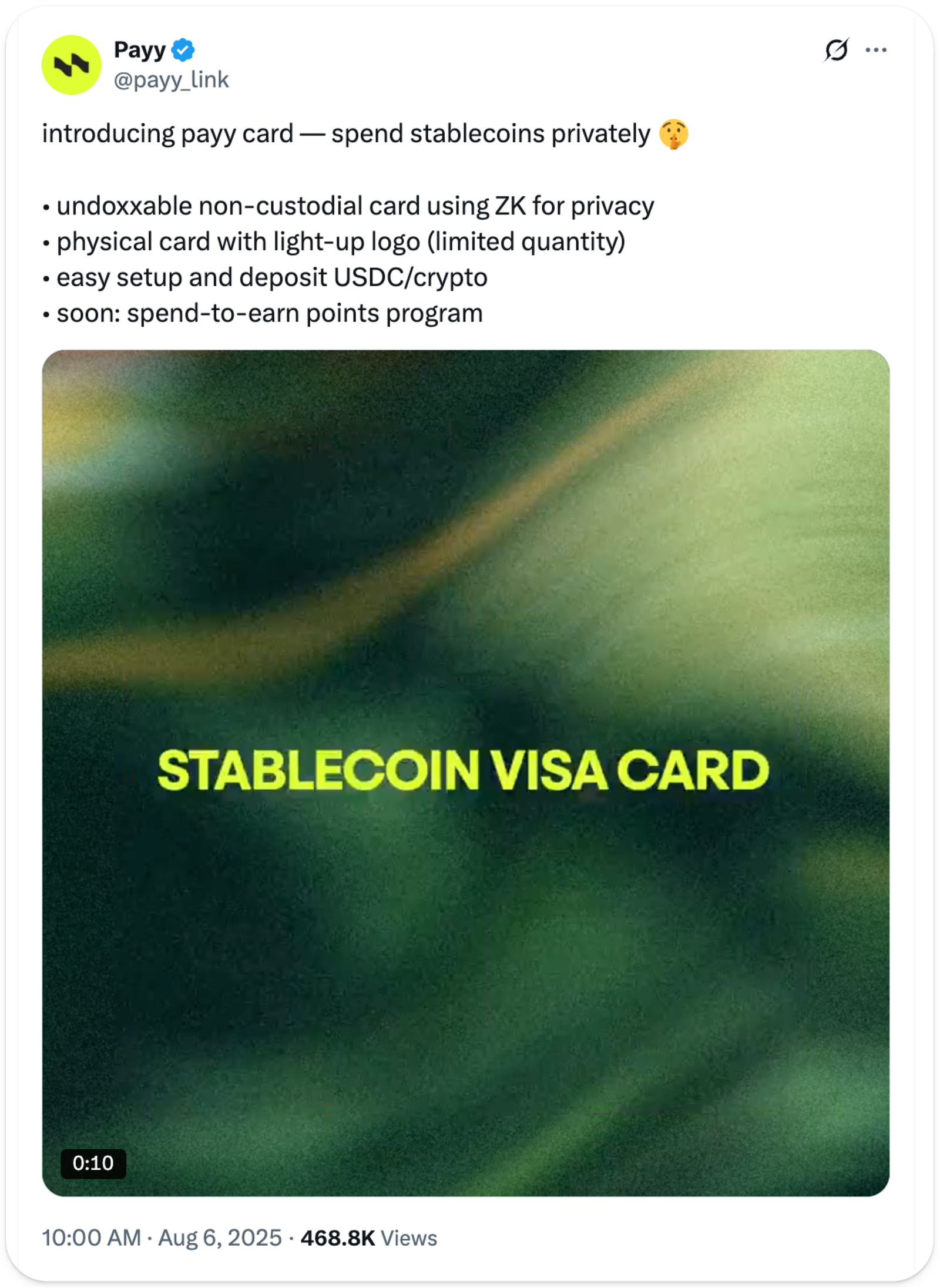
📸 Daily Market Snapshot: Crypto markets continued their slide over the weekend, with ETH briefly falling below $4,300 and BTC dipping below $115K. | Prices as of 5pm ET | 24hr | 7d |  | Crypto $3.94T | ↘ 1.5% | ↘ 0.5% |  | BTC $116,296 | ↘ 1.3% | ↘ 2.3% |  | ETH $4,340 | ↘ 3.0% | ↗ 2.0% | . . . TACTIC Spend Stablecoins Privately With Payy Card Today, we're looking beyond tools for living privately onchain to one focused on extending privacy beyond the blockchain and into daily life. Payy is a blockchain-based platform for privately spending stablecoins like USDC in everyday environments, whether that be a coffee shop or an online store. Backed by reputable funds like Protocol Labs and Robot Ventures, the project weaves together three interconnected components: the Payy Network, Payy Wallet, and the Payy Card, to let you spend crypto in daily settings without exposing your entire transaction history to the world. Here’s how all these pieces intersect and how you can get started. 👇 The Payy NetworkAt the heart of Payy sits its own privacy-preserving blockchain, Payy Network, built as a rollup on Polygon. The network uses a UTXO (Unspent Transaction Output) system (similar to general-purpose, privacy-focused L2 Aztec recently covered), where assets are tracked as "notes" — digital vouchers holding value, ownership, and random data for security. When sent or “spent,” these original notes are "destroyed," creating new, unlinked notes for the payment and any change, hiding the transaction trail. For example, to send $7 from a $10 UTXO, the $10 note is “spent” and destroyed, with new notes created: a $7 note for the recipient and a $3 change note for you at new addresses. It’s a lot like paying with cash and, when combined with zero-knowledge proofs (ZKPs), ensures no public link ties the new notes to the original. To support the scale needed for everyday payments, Payy Network batches transactions, allowing it to process thousands per second with users receiving soft finality in about one second. Full Ethereum confirmation arrives in roughly six minutes. Overall, the network handles three main transaction types: - Depositing — Lock funds on Ethereum to mint corresponding notes on Payy
- Transferring — Spend existing notes to create new ones
- Withdrawing — Burn notes on Payy to unlock the original funds back on Ethereum
Like more and more privacy tools these days, Payy comes loaded with compliance features as well, ensuring funds don’t come from blacklisted sources, tracking lineage while still keeping data private via ZK proofs. The network also boasts cross-chain support for stablecoin deposits on Arbitrum, Base, and Polygon. The Payy WalletWhile Payy Network makes these services possible on the backend, Payy Wallet, a non-custodial mobile wallet for iOS and Android, provides the interface for accessing them on the frontend. In the wallet, users can deposit funds via multiple routes, whether through fiat (live in Argentina, in beta in the U.S.), or through existing crypto wallets and exchanges. Sending payments happens through shareable links with no fees or gas costs — the wallet abstracts away complexities like addresses, intending to make crypto payments as simple as those on Venmo. The Payy CardPerhaps the most tangible, and certainly the most standout, component of Payy’s stack is the Payy Card — a U.S.-issued Visa card that lets you spend USDC from your wallet privately anywhere Visa is accepted. Setup is straightforward, involving only basic KYC (ID and address verification) with no credit check required. You get an instant virtual card upon approval, with the option to request a physical card as well after earning 100K Payy points (from spending and referrals). Payy Points — A "spend-to-earn" rewards program tied to Payy Card usage. This system will let users accrue points ($1 = 1 point) for transactions, redeemable for ecosystem benefits.
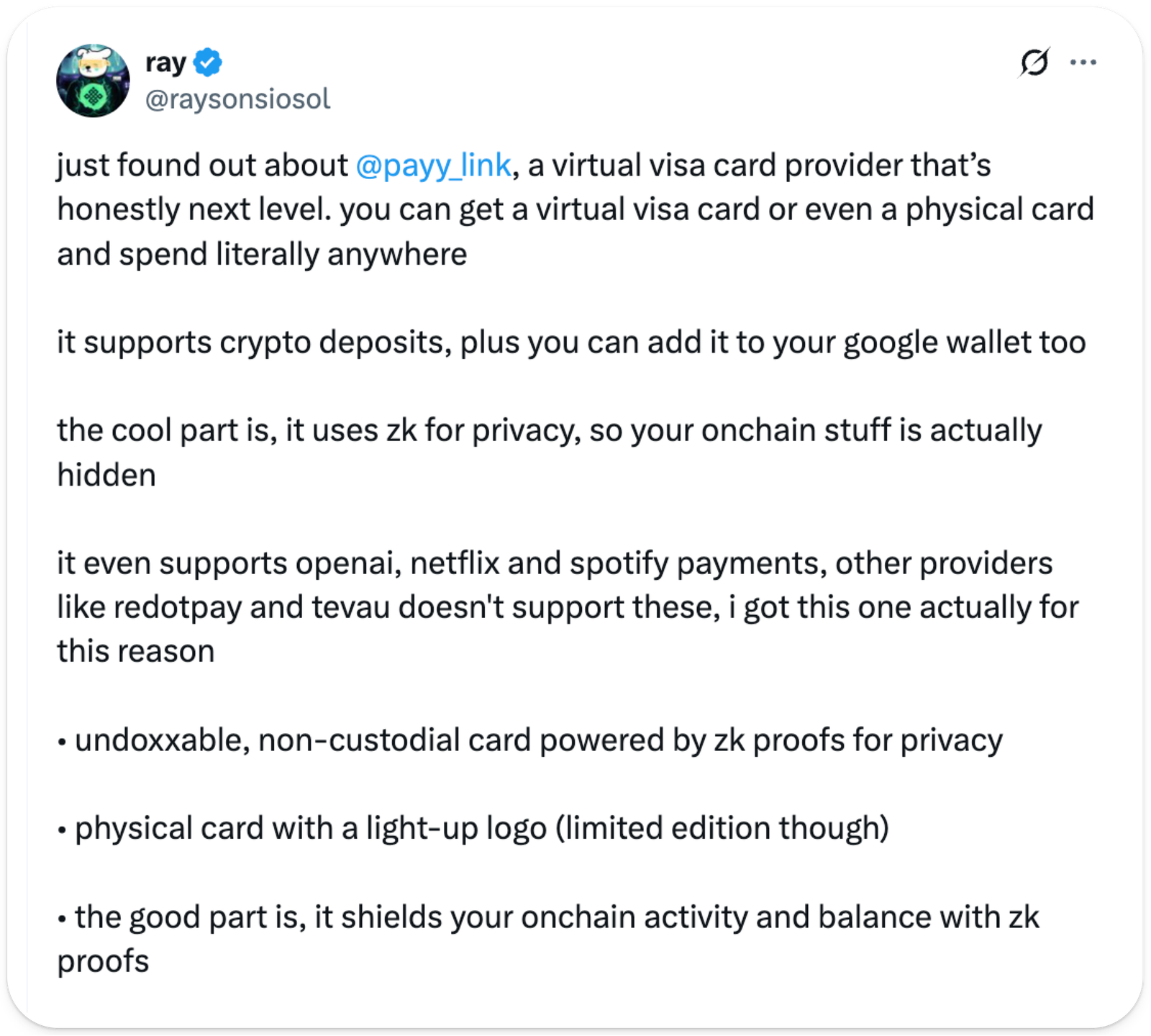
As promised, Payy’s privacy architecture extends to card transactions. Each purchase uses UTXOs and ZK proofs on the Payy Network, ensuring no public exposure of addresses or values. Your coffee purchase remains completely unlinkable to your wallet activity or other transactions. The fee structure is straightforward: no application or transaction fees (except a 1% foreign exchange fee for international purchases). The app even provides standard card controls like a freeze/unfreeze feature. Further, Payy Card also works with platforms that many crypto cards don't support, including OpenAI, Netflix, and Spotify. Getting Started with PayyIf you’re interested in testing Payy out, simply: - Download the Payy Wallet — Grab the app for iOS or Android from your mobile app store.
- Fund your Wallet — You can transfer USDC (primarily on Polygon) or other supported stablecoins from existing wallets or exchanges.
- Order Your Card — Once your wallet has funds, request your Payy Card through the app. You can instantly apply for a Virtual Card, though, as mentioned, you need to earn 100K Payy Points via spending or referrals to request a physical card.
- Add to Your Digital Wallet — Once done, go to your Apple Wallet or Google Pay and add your card information manually. This lets you tap to pay in stores just like any other card, except your transactions remain private onchain.
- Start Spending Privately — Use your card anywhere Visa is accepted — online stores, physical retailers, even subscription services. Payy Network will keep your spending habits and balances shielded from public view.
At the end of the day, what I like about Payy is how it demonstrates blockchain’s ability to introduce, then extend, privacy into one’s financial life. As privacy-focused infrastructure continues maturing, projects like Payy reveal what a world augmented by crypto looks like, where financial privacy can be a foundational feature, rather than just an afterthought. In this day and age, it’s not just about obscuring activity, it’s about ensuring protection in a world increasingly riddled with financial crimes and data leaks, where, like it or not, most everyone comes with a target painted on their back. FRIEND & SPONSOR: UNICHAIN Unichain offers the most liquid Uniswap v4 deployment on any L2 – giving you better prices, less slippage, and smoother swaps on top trading pairs. All on a fast, low-cost, and fully transparent network. Start swapping on Unichain today. . . . LATEST POD Why Passive Investors Lose Contrarian strategist Michael Green lays out why “passive” isn’t passive at all — it’s a flow-driven algorithm, turbocharged by policy, that funnels capital into mega-caps, starves small caps, and raises the odds of market non-clearing shocks.
We unpack Sharpe’s arithmetic vs. rebalancing reality, lessons from Volmageddon, the aging of investor cohorts, why stress may be deflationary before inflationary, and how to “doom-proof” a portfolio with assets that throw off cash (including overlooked duration/TIPS and munis).
Michael also separates crypto’s burn-it-down narrative from its true promise: tokenized, programmable securities that fix TradFi’s paper plumbing. Listen to the full episode 👇 | 




No comments:
Post a Comment