Wall Street Meets ETH, Again gm Bankless Nation,
BlackRock's staked ETH ETF went live today, and Wall Street is finally getting their eyes on an ETF with the 'internet bond' in action. Become a Premium member to get all of the alpha! Today's Issue ⬇️ - ☀️ Need to Know: Prediction Rules
The CFTC lays out new guidelines. - ✍️ Cheat Sheet: Futarchy Markets
Premium-only opps, reads, yields, and airdrops. - 🗣️ Deep Dive: Wall Street Meets ETH, Again
BlackRock’s staked ETH ETF goes live.
p.s. Thanks to Figure. Explore Democratized Prime while earning ~9% APY or take out a Crypto-Backed Loan at 8.91% interest rates with 12-month terms!
Sponsor: Mercuryo — Infrastructure powering the crypto economy.
. . . NEED TO KNOW New Prediction Market Rules - 🏈 CFTC Issues New Guidance for Regulated Prediction Market Operators. The financial regulator warns that exchanges should avoid listing contracts that could be easily manipulated, such as sports-related markets.
- 🗿 BlackRock Launches Staked ETH ETF, Trading Begins Today. The much-anticipated staked ETH ETF goes live on Nasdaq today, combining spot ETH exposure with staking rewards in a single fund.
- 🌎 Vitalik: The Real World Needs Blockchains. Vitalik postulates that the crypto industry is on the precipice of achieving new types of real-world adoption.
📸 Daily Market Snapshot: Stock market indices cratered Thursday as Iran's new Supreme Leader vowed to keep the Strait of Hormuz closed. | Prices as of 5pm ET | 24hr | 7d |  | Crypto $2.40T | ↘ 0.4% | ↘ 1.1% |  | BTC $70,241 | ↘ 0.6% | ↘ 1.3% |  | ETH $2,060 | ↘ 0.4% | ↘ 1.0% | . . . CHEAT SHEET Futarchy Markets Once a week, Premium subscribers get access to the top Market Plays, Hot Reads, Farming Opps, and Airdrop Hunts that our analyst team is tracking! Don't miss out! 👇 . . . PLAY OF THE WEEK Wall Street Meets Ethereum's Secret Sauce BlackRock’s iShares Staked Ethereum Trust ETF (ETHB) began trading on Nasdaq today. It’s the firm’s first staking fund, and it quietly resolves a problem that’s hung over Ethereum’s institutional story since spot ETFs launched. For the first time, Wall Street can access ETH the way it’s been pitched: as a productive, yield‑bearing asset. The DisconnectFrom day one, spot ETH ETFs have created a mismatch. Ethereum has been sold to institutions as an “internet‑native bond” – scarce (boasting an issuance cap of 1.5% a year), yield‑bearing (compounding 3-5% a year), and embedded in the settlement layer of a new financial system (stablecoins and tokenized assets). Etherealize formalized this framing last year: ETH as digital oil, productive collateral, and reserve asset all rolled into one. Even if slightly “outlandish,” the pitch still landed, as we saw when DATs heralded the asset as a vehicle for gaining exposure to stablecoins. Yet, the product didn’t. Spot ETFs arrived without the yield. Investors got price exposure 😬, but none of Ethereum’s economic engine. We pitched a productive asset and then handed institutions a non‑productive wrapper. Bitcoin didn’t have this issue. The beauty of BTC’s value proposition is its simplicity: store of value. Hold it. Spot exposure delivers the full thing. Ethereum’s proposition is different. Staking is integral to the asset. It’s how holders benefit from network economics and earn the compounding that underwrites the thesis. Spot ETFs couldn’t offer that. While not the only reason, this dynamic led to institutional ETH flows badly lagging. While IBIT now holds north of $55 billion, ETHA sits around $6.5 billion. Sure, some of that gap reflects Bitcoin’s first‑mover advantage and a cleaner narrative. But some of it reflects product failure. Institutions were sold Ethereum’s upside and given a truncated version of the asset. Wall Street Is Already HereThat asset-related underperformance tends to mask the institutional adoption of Ethereum that’s taken place since spot ETFs launched in July 2024. RWA supply on Ethereum has grown roughly sevenfold. Stablecoin supply has more than doubled. Wall Street increasingly treats ETH as infrastructure, the rails for stablecoins and tokenized finance, rather than as a standalone trade. 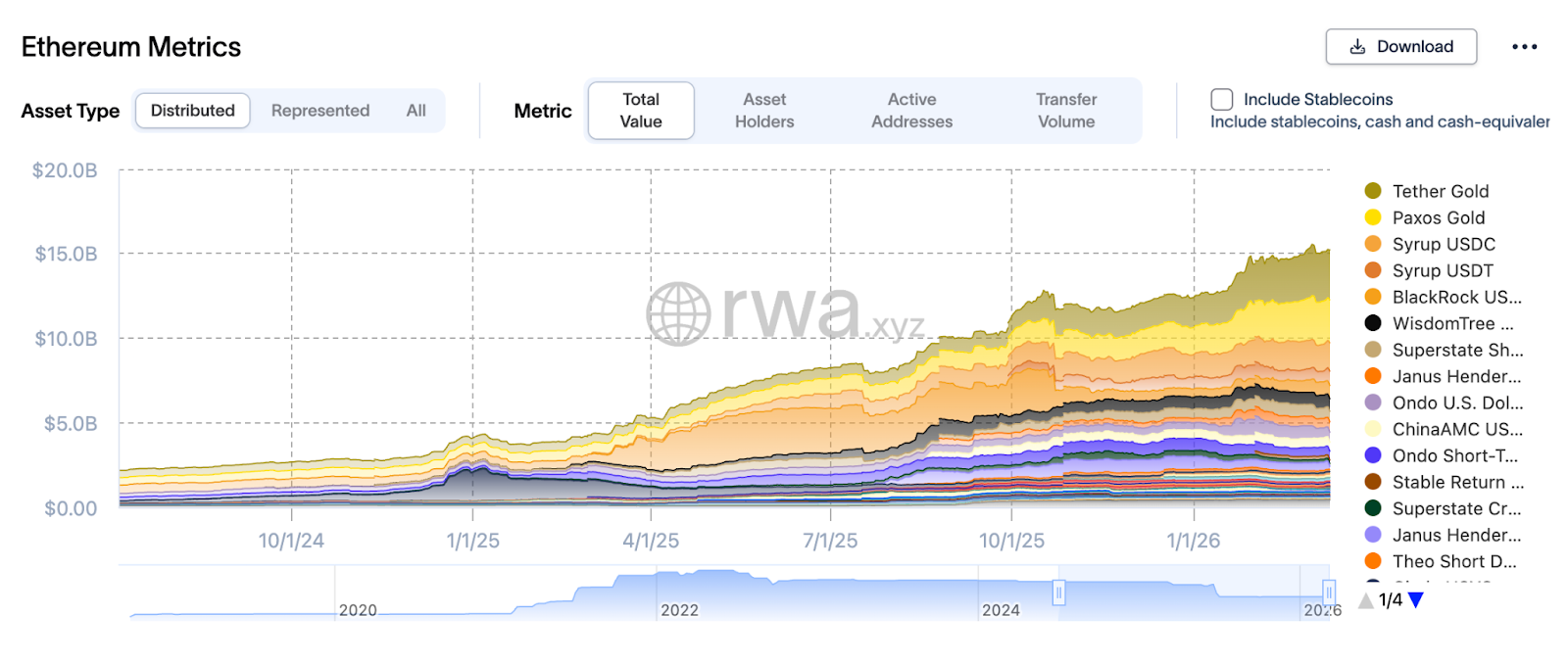 RWA Growth on Ethereum from July 2024 to now. BlackRock’s BUIDL fund, Franklin Templeton’s FOBXX, and a growing slate of tokenized money‑market products all settle on Ethereum or its L2s. Banks are testing onchain settlement. So is SWIFT. The institutional footprint is expanding in practice, even though ETF flows disappoint. But some part of these flows is again in the lack of proper access to ETH rather than in demand for it. Institutions could hold ETH price exposure, but not participate in the network they were increasingly using, seeing used, or, at the very least, finally understanding the value in. ETHB fixes that. For the first time, institutions get a regulated wrapper that actually matches Ethereum’s pitch. 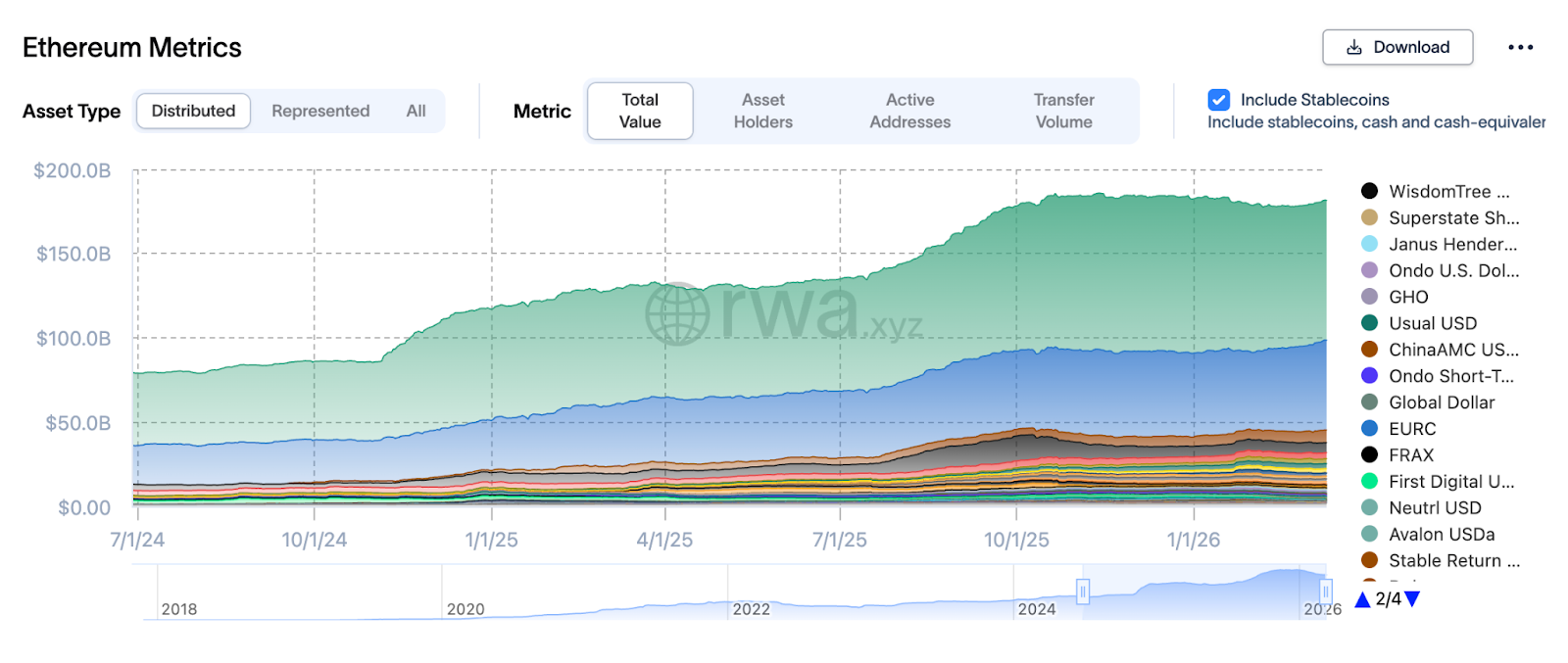 Stablecoin Growth on Ethereum from July 2024 to now. Structural ImplicationsThis matters beyond ETHB itself. Until now, non-crypto-native investors who wanted productive ETH exposure had to use workarounds: primarily DAT‑style structures which had the freedom to stake, restake, use DeFi, though whose value had no direct link to the assets they held. In part, those structures existed because institutions couldn’t access staking directly within their mandates. With staking ETFs live, that proposition weakens. Capital that previously had to route through intermediaries can now flow directly into ETH itself. The SetupETHB comes online with ETH sitting in fair‑to‑deep value territory by most cycle metrics, according to the DeFi Report. MVRV is below 1, meaning the market is underwater on aggregate cost basis. Supply in profit is lower than during the 2022 capitulation. This cycle barely exceeded the 2021 highs (sorry to remind you), trading inside the prior range rather than breaking out. By historical standards, price is attractively compressed. As I mentioned, this underperformance can’t simply be chalked up to no staking ETFs. Ethereum’s L2 roadmap optimized for scale and UX, not L1 fee capture. Blobs made rollup anchoring cheap and collapsed the fee burn that once supported the deflationary narrative. Sure, Ethereum as a network improved but its investment story got harder to model. Yet, the monetary structure was by no means broken. Annualized issuance sits around 0.8%, roughly in line with Bitcoin’s inflation rate. And now the pieces are lining up again. Institutional usage is clearly and consistently accelerating, with RWAs, stablecoins, tokenized funds all growing on Ethereum. The staking wrapper finally exists, with price in value territory. Ethereum has been pitched to institutions for years as a yield‑bearing reserve asset and settlement layer for a tokenized economy. The story has been refined, formalized, and repeated: dangled in front of institutions who clearly see the network’s value but couldn’t partake in ETH’s economic proposition. With the wrapper finally matching the thesis, ETHB will be the test. We’re about to find out whether Wall Street actually buys what Ethereum, as an asset, has been selling. FRIEND & SPONSOR: MERCURYO If you're building in crypto, your users need a way in — and a way out. Mercuryo's on- and off-ramp infrastructure is trusted by leading wallets and platforms to move money fiat to crypto and back in seconds. White-label ready, globally licensed, and built for scale. | 







No comments:
Post a Comment