
The Four-Year Cycle Bitcoin Playbook May No Longer ApplyWith 95% of supply already mined, Bitcoin’s price is now driven more by global liquidity and institutional flows than halving cycles.
There’s a version of Bitcoin analysis that’s fairly simple: wait for the halving, expect a bull market for the following year or so, expect a bear market for roughly a year after that, repeat. It’s a framework that made sense for most of Bitcoin’s history. I’m not sure it does anymore, and this week I want to explain why, and what I think we should be looking at instead. This week at a glance:
Less RelevantThe halving has historically been one of the most significant structural drivers of Bitcoin’s four-year cycle. An immediate 50% reduction in the daily supply of new coins entering the market is a meaningful economic event, and for much of Bitcoin’s history, when the asset was smaller, less liquid, and predominantly retail-driven, its price impact was substantial and relatively predictable.
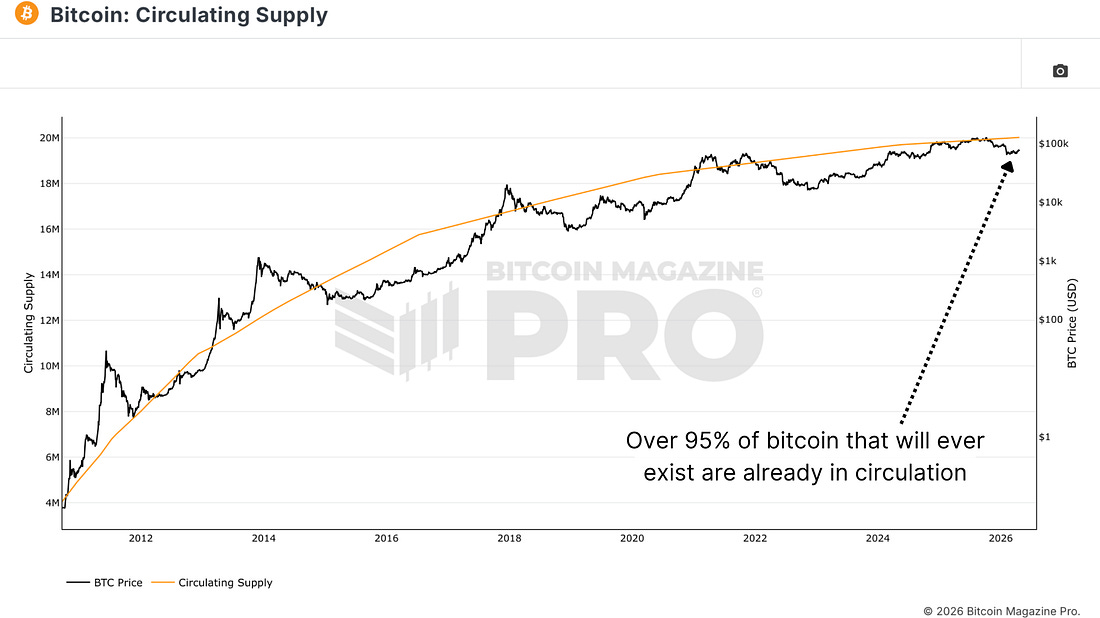
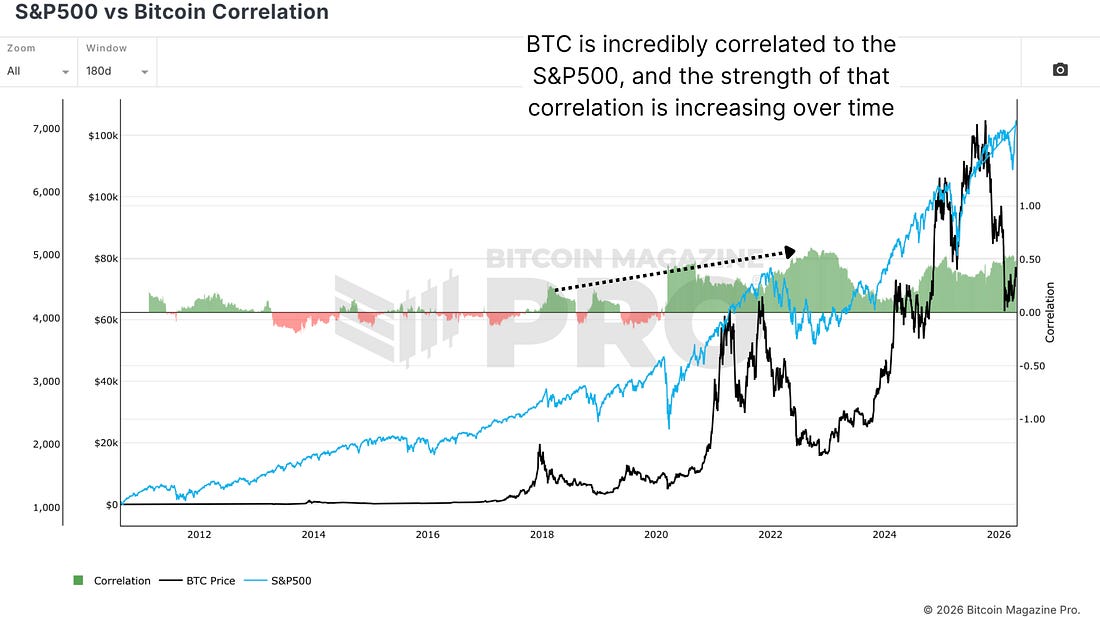
Figure 1: 95% of the finite 21 million bitcoin are already in circulation. Over 95% of all bitcoin that will ever exist is already in circulation. The inflationary rate is already so low that halving it again moves the needle considerably less than it once did. Meanwhile, Strategy alone is currently absorbing more than twice the entire daily new supply of bitcoin through ongoing accumulation. ETFs bought close to $650 million of bitcoin in a single day recently. The structural demand now entering this market dwarfs the supply changes that the halving produces. LiquidityThe S&P 500 has a 96% correlation with Global M2 liquidity over the past 15 years on the monthly chart. Bitcoin has an 85% correlation with Global M2 over the same period. Closer to home, Bitcoin’s correlation with the S&P 500 itself sits at 93% over the same timeframe. These aren’t loose relationships; they’re some of the strongest cross-asset correlations in markets, and they tell you that what drives Bitcoin is predominantly the same macro force driving all risk assets: the availability of capital.
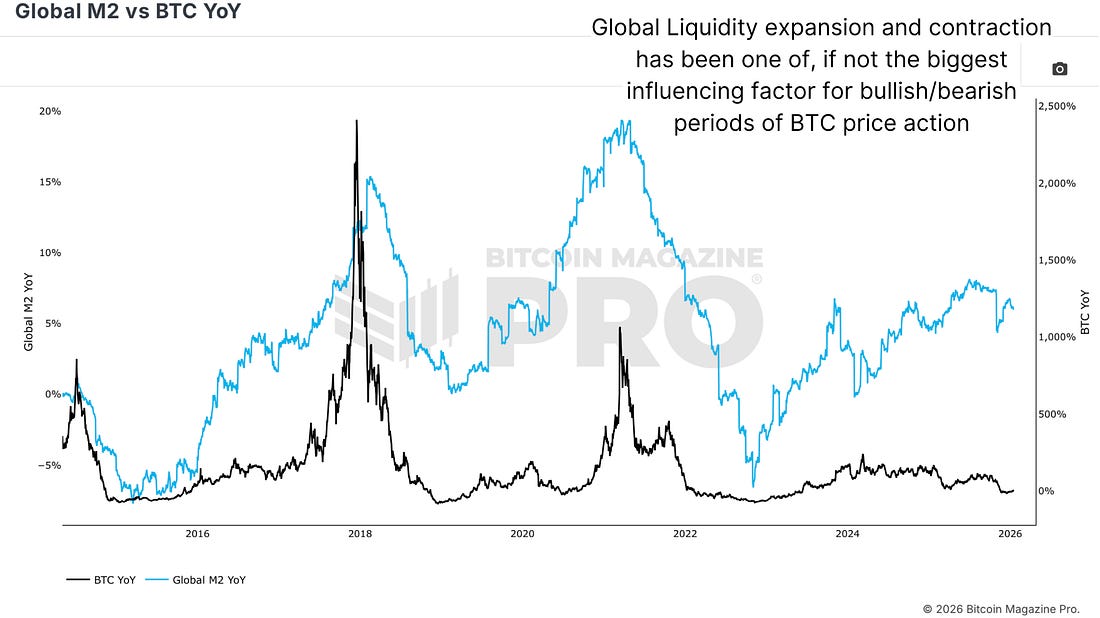
Figure 2: Bitcoin’s correlation to the S&P500 is increasing. When you look at Global M2 on a year-on-year basis, measuring the rate of expansion and contraction rather than just the nominal level, Bitcoin’s alignment with liquidity cycles becomes even clearer. After a period of deceleration, the year-on-year M2 trend is beginning to show early signs of turning, which historically has been a meaningful tailwind for both equities and Bitcoin. If the four-year cycle framework is becoming less reliable, the question is what to replace it with. The answer, supported by over a decade of data, is global liquidity.
Figure 3: Viewing Global M2 liquidity on a year-on-year basis illustrates its influence on Bitcoin.
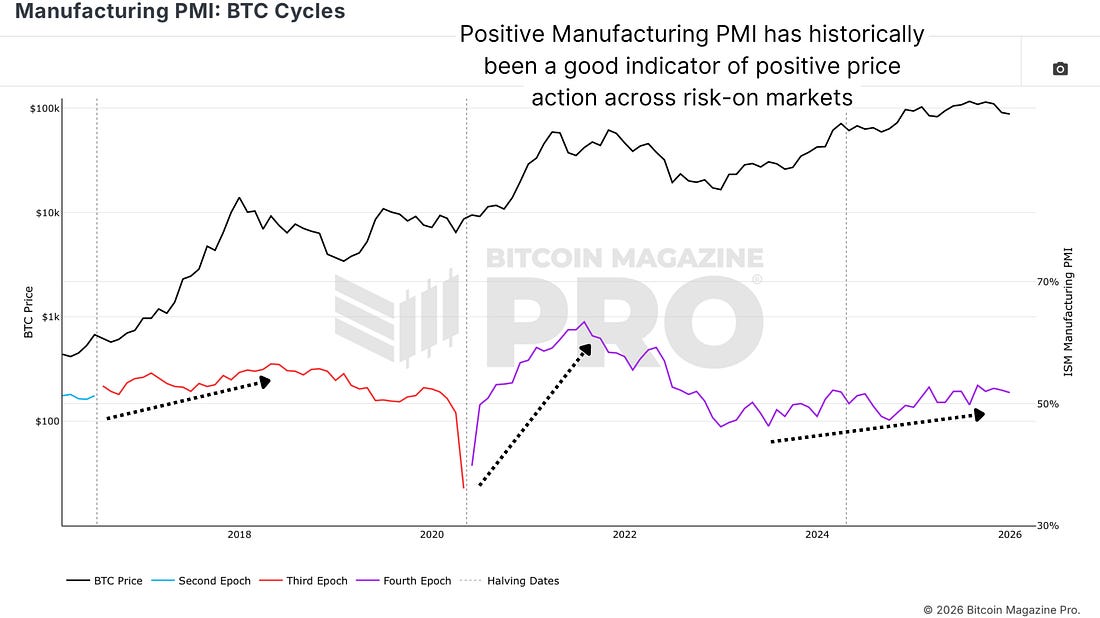
Shifting Macro SignalsBeyond raw liquidity, the ISM Purchasing Managers Index, a measure of confidence and forward expectations in US manufacturing, has a historically strong correlation with Bitcoin price performance. When manufacturing sentiment improves, Bitcoin has tended to follow. We’re currently seeing early signs of recovery in this indicator after a period of deterioration, which, combined with the liquidity picture, suggests the macro backdrop is becoming more supportive rather than less.
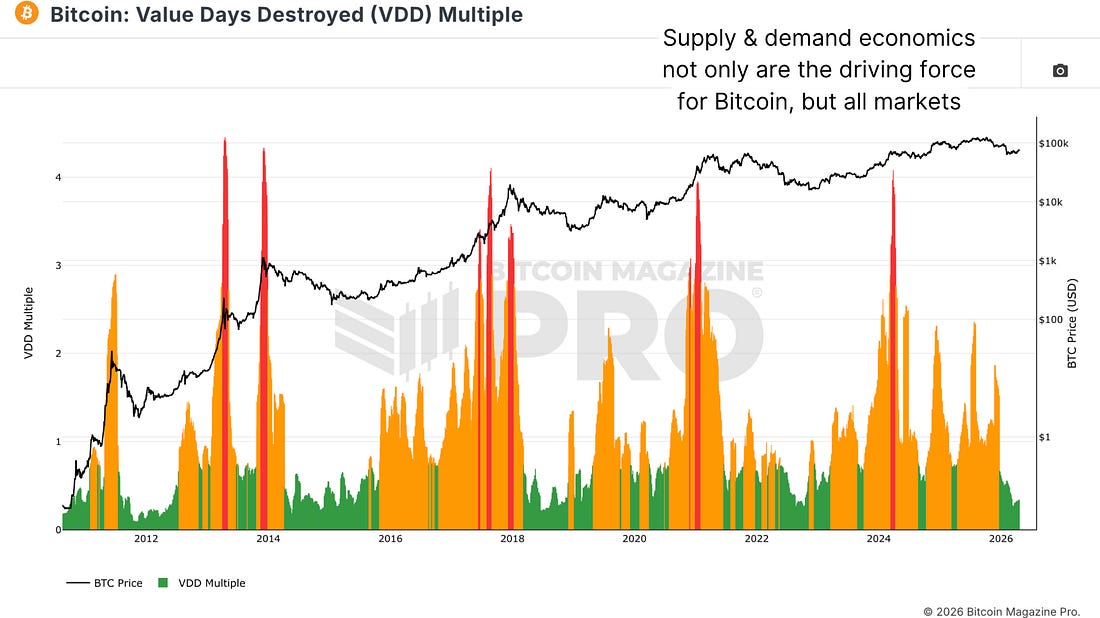
Figure 4: The historical relationship between Manufacturing PMI and Bitcoin price action. On-Chain DataSeparately from the macro picture, the on-chain data is pointing in the same direction. The Value Days Destroyed Multiple, which weights coin movement by both the USD value and the dormancy of the coins being moved, then compares a 30-day average to the prior year’s average, has just entered its accumulation zone. This metric has a strong historical track record of identifying both overheated conditions at cycle peaks and undervalued conditions at cycle lows, and it’s currently at some of its lowest readings in recent history.
Figure 5: The VDD Multiple has historically been a strong indicator of cycle highs and lows. Closing ThoughtsLiquidity is expanding. Manufacturing sentiment is recovering. Institutional demand is structurally absorbing multiples of the daily new supply. And the on-chain data is pointing toward accumulation territory independent of where we sit on a four-year cycle timeline. This doesn’t mean cycles disappear. It means the halving is no longer the primary engine driving them, and waiting for a calendar date to dictate accumulation timing is increasingly difficult to justify with data. For a more in-depth look into this topic, watch our most recent YouTube video here: I Think The Bitcoin 4 Year Cycle Is Over, 93%+ Chance We Follow This 
Matt Crosby Director of Research & Analytics Bitcoin Magazine Pro
For more detailed Bitcoin analysis and to access advanced features like live charts, personalized indicator alerts, and in-depth industry reports, check out Bitcoin Magazine Pro. Make Smarter Decisions About Bitcoin. Join millions of investors who get clarity about Bitcoin using data analytics you can’t get anywhere else. We don’t just provide data for data’s sake, we provide the metrics and tools that really matter. So you get to supercharge your insights, not your workload. Take the next step in your Bitcoin investing journey:
Invest wisely, stay informed, and let data drive your decisions. Thank you for reading, and here’s to your future success in the Bitcoin market! Disclaimer: This newsletter is for informational purposes only and should not be considered financial advice. Always do your own research before making any investment decisions. We sincerely appreciate your support and hope you found this content valuable. Please leave a like and let us know your thoughts in the comments section; we always welcome feedback from our audience!
|








No comments:
Post a Comment