
Bitcoin ETF Flows Stall As Bitcoin Tests Long-Term TrendAlso Bitcoin ETF Demand Still Points To A Recovery Regime & Inflation Pressures Are Starting To Broaden Again
Welcome to Ecoinometrics’ Friday edition. Each week, we analyze the three most critical market signals impacting Bitcoin and macro assets, delivering institutional-grade insights through data-driven charts and analysis. Today we’ll cover:
Bitcoin’s recovery is continuing, but the macro backdrop still quite complicated. This week we’ll look at the recent slowdown in ETF flows, the broader recovery trend in institutional demand, and the renewed rise in inflation pressures shaping the market environment. In case you missed it, here are the other topics we covered this week:
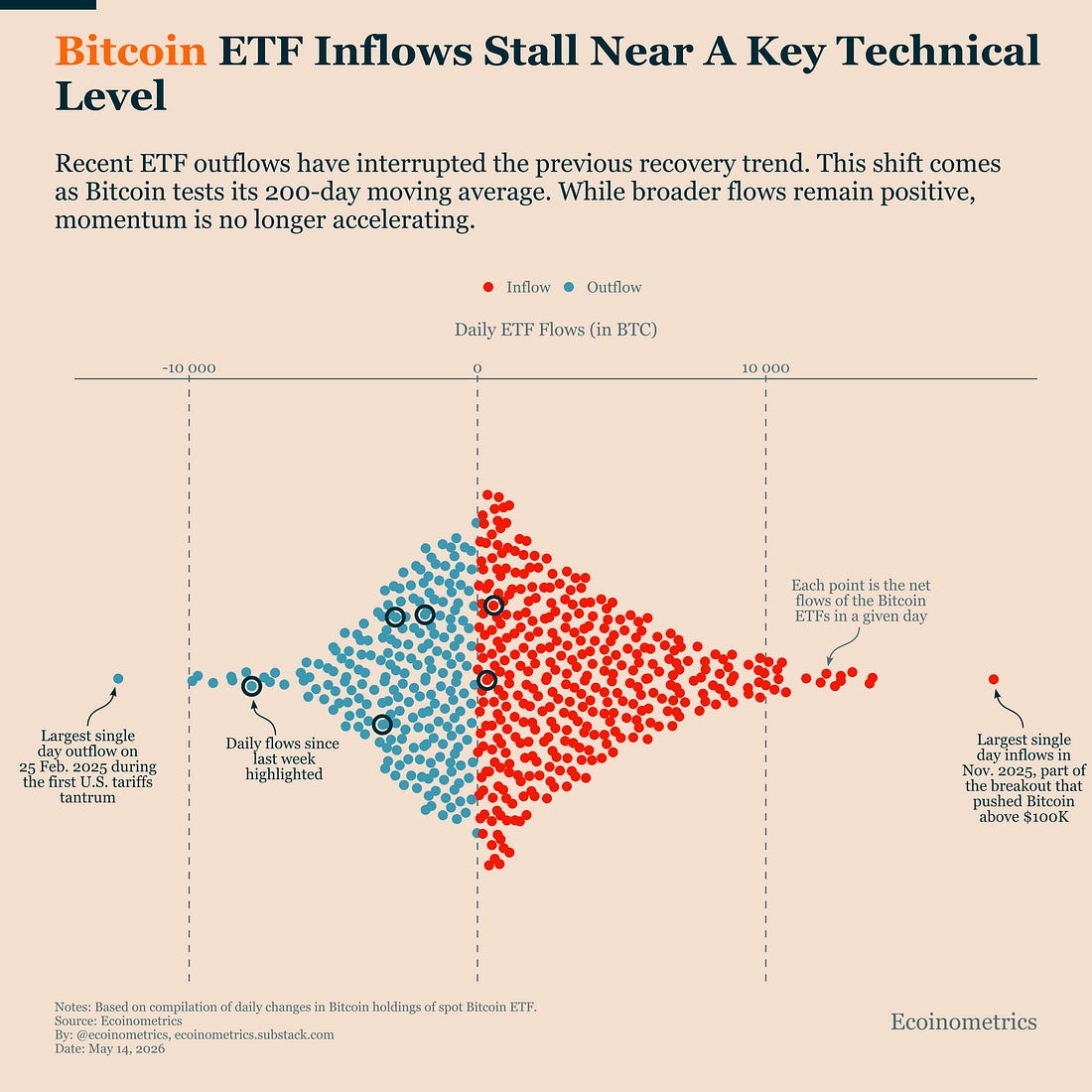
Get these professional-grade insights delivered to your inbox: Bitcoin ETF Flows Stall As Bitcoin Tests Long-Term TrendBitcoin has spent the last week testing its 200-day moving average, but so far the market has failed to reclaim that long-term trend level. At the same time, ETF demand has clearly cooled down. Over the last seven days, spot Bitcoin ETFs recorded roughly -14K BTC in net outflows, interrupting the steady recovery in institutional demand that had been building since April. That slowdown is happening for understandable reasons. The most important of which being that inflation fears are rising again. We’ll discuss this more in the last section. But it is clear that from time to time investors look at this trend and probably feel uneasy about pushing exposure aggressively without knowing what the Fed will do. Still, the broader picture does not yet point to a major deterioration in risk appetite. Even after the recent pullback, 30-day ETF flows remain positive and U.S. equities continue to behave more like a market digesting macro uncertainty than one transitioning out of a risk-on regime. The recent outflows look more like hesitation near an important decision point than the beginning of a broader unwind in positioning. For now, the key question is whether ETF demand stabilizes again once Bitcoin either clears or rejects the 200-day moving average. That will tell us far more about the durability of this recovery than any single day of flows.
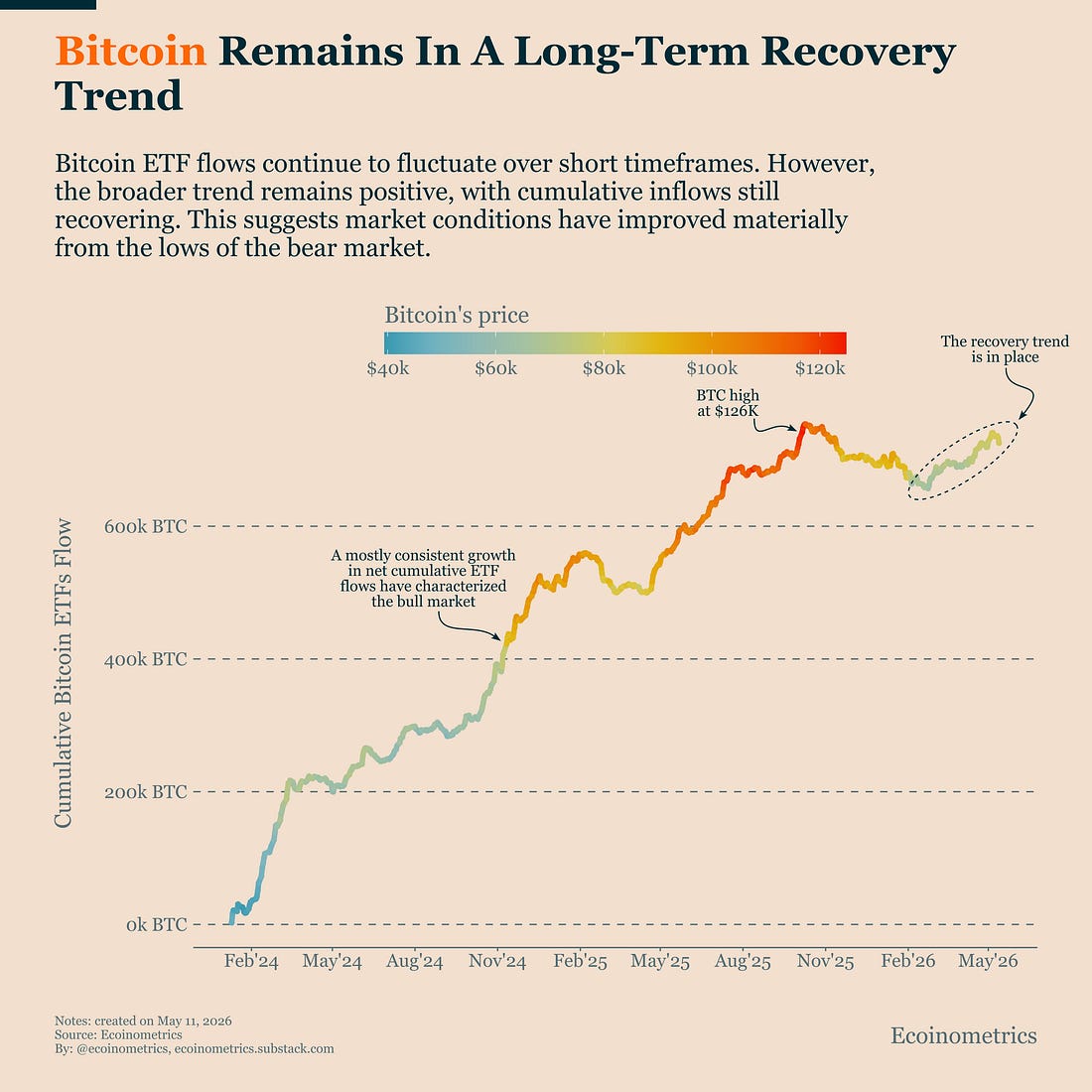
Bitcoin ETF Demand Still Points To A Recovery RegimeDaily ETF flows have clearly become more volatile since last week. But when you step back and look at the broader trend, the structure of the market still looks materially healthier than it did during the acute bear market phase earlier this year. The chart below shows the cumulative net flows of the spot Bitcoin ETFs since launch. And despite the recent slowdown, the overall direction remains clear: institutional capital continues to move back into Bitcoin over time. Those cumulative flows tell us far more about market structure than any single day of inflows or outflows. Short-term positioning can fluctuate around macro headlines, inflation fears, or technical levels. But sustained growth in cumulative ETF holdings usually reflects something deeper: large investors gradually rebuilding exposure instead of exiting the asset class altogether. Which is basically another way of saying we are in a bear market recovery regime. The recent weakness in flows is noticeable, but it has not meaningfully damaged the broader recovery pattern. To materially change the balance of risk here, we would likely need to see a prolonged sequence of outflows large enough to flatten or reverse the cumulative trend itself. For now, we are nowhere near that point. The recovery structure remains intact.
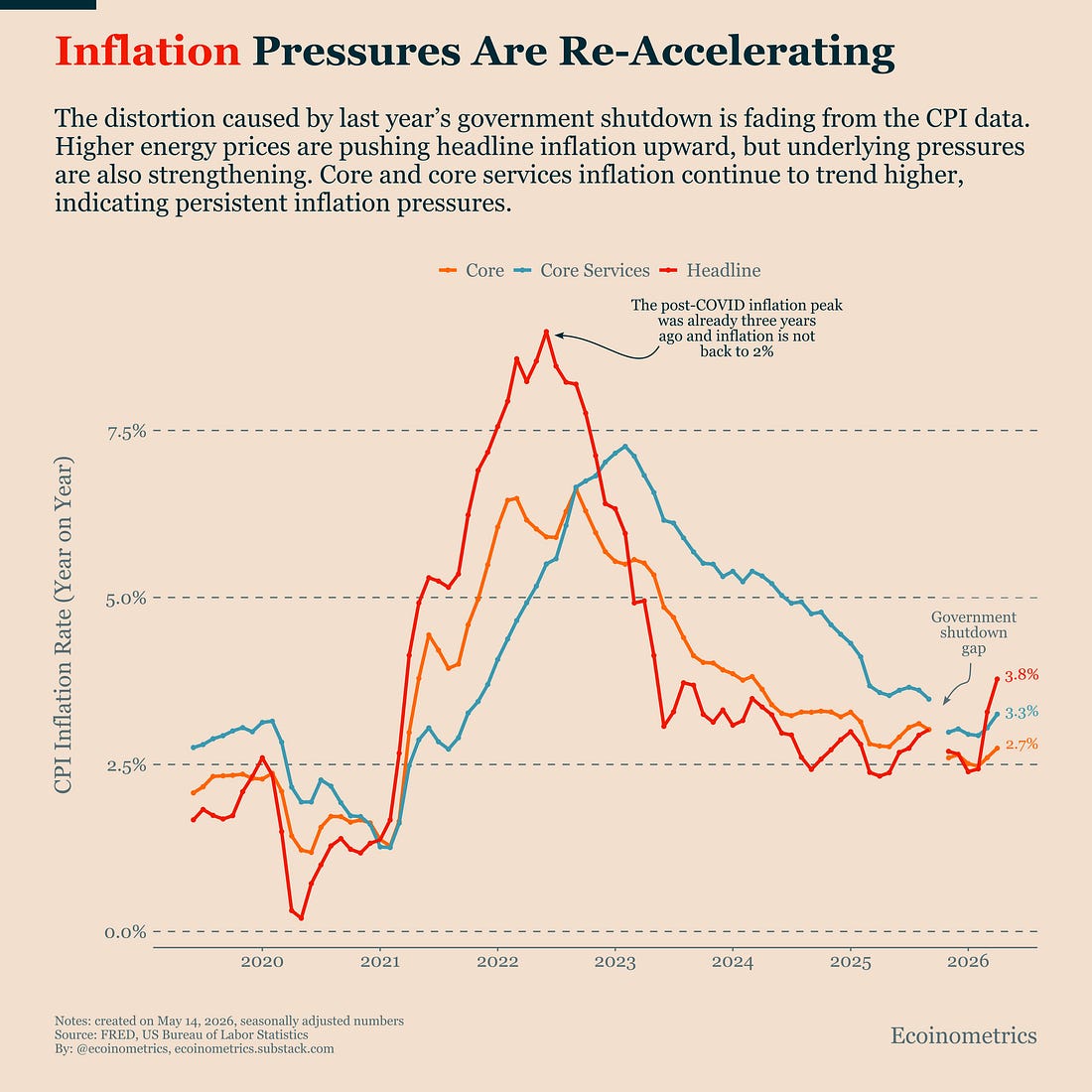
Inflation Pressures Are Starting To Broaden AgainWe spend a lot of time discussing inflation in our reports because, sooner or later, inflation will dictate the boundaries of what risk assets can sustain. And this week’s CPI report reinforced that the inflation problem is becoming broader again. Headline inflation jumped higher, which was largely expected after the sharp rise in energy prices following the conflict with Iran. But the more important development is happening underneath the surface. Core inflation and core services inflation are also turning higher again. Those measures are much less sensitive to short-term moves in energy markets and tend to reflect more persistent inflation pressures inside the economy. If headline inflation alone was rising while core measures stayed stable, markets could reasonably treat the move as a temporary energy shock. Instead, we are seeing broader inflation pressures strengthening at the same time energy prices are elevated. The chart also highlights another important detail. Last year’s government shutdown temporarily distorted parts of the inflation data lower because of missed data collection. That artificial weakness is now fading from the year-on-year comparisons, making the underlying inflation trend look firmer again. Bond markets are already reacting to that reality, with Treasury yields continuing to move higher. For now, risk assets are largely absorbing the pressure without major damage. Bitcoin, equities, and other risk-sensitive assets still benefit from improving positioning and recovering demand, even though there are short term reactions around each data release. But the truth is that the macro backdrop is becoming less forgiving underneath the surface. That does not mean investors should suddenly turn defensive. But it does mean the margin for error is shrinking if inflation continues moving in the wrong direction over the next few months. As usual the key point will be to see how the Federal Reserve reacts to that.
Tactical TakeawayIt still makes sense to be long Bitcoin at the moment, but the pace at which investors increase risk probably needs to slow down from here. For now, the market still looks more like a recovery pausing near an important decision point than the start of a broader breakdown in risk appetite. But the environment is becoming less forgiving underneath the surface, especially if inflation pressures get the Fed to become more hawkish. So our guidance remains to gradually build or maintain exposure while the broader ETF recovery trend stays intact. What would force us to reassess that is a sustained deterioration in cumulative ETF flows together with continued upward pressure in core inflation and Treasury yields. If those trends start reinforcing each other, the probability of a more durable macro headwind for Bitcoin would increase materially. That’s it for today. Thanks for reading. Cheers, Nick P.S. Every week, our team conducts extensive research analyzing market data, tracking emerging trends, and creating professional-grade charts and analysis. Our mission: Deliver actionable macro and Bitcoin insights that help institutional investors and financial advisors make better-informed decisions. Ready for institutional-grade research that puts you ahead of the market? Click below to access our premium insights. Invite your friends and earn rewards
If you enjoy Ecoinometrics, share it with your friends and earn rewards when they subscribe.
|






No comments:
Post a Comment