
For years, on-chain analysis has relied on a single number to separate Bitcoin’s committed holders from its short-term traders: 155 days. Hold your Bitcoin longer than that, and you’re classified as a long-term holder. It’s one of the most widely used thresholds in the entire field, and it underpins a huge number of the metrics analysts rely on every day. I’ve spent a considerable amount of time digging into whether a static threshold still makes sense, and built a more dynamic approach that I think is more accurate and more useful. Let’s cut to the chase:
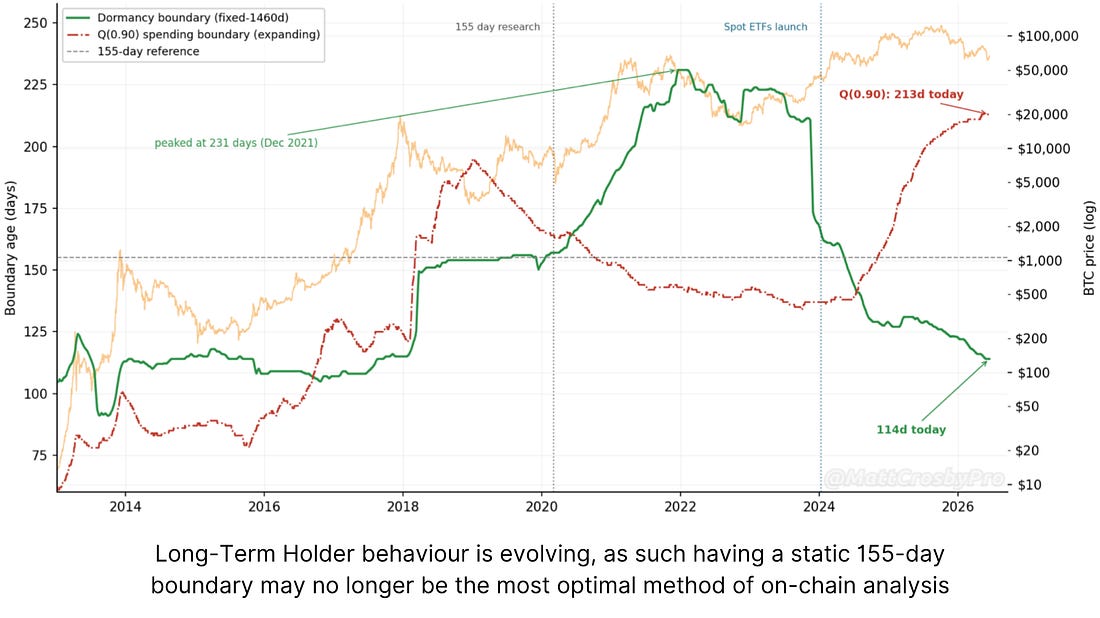
A Fixed Threshold No Longer FitsThe original logic behind the 155-day mark was sound. It’s the point at which the probability of a holder spending their Bitcoin drops off sharply and then flattens out. Past that point, statistically, people tend to hold. The problem is that Bitcoin’s holder behaviour has shifted dramatically. Fewer people are using it as a peer-to-peer payment system, and far more are holding it indefinitely as a store of value, driven significantly by ETFs and treasury companies. When the broad behaviour of the network changes this much, a fixed threshold set six years ago starts to potentially misrepresent what’s actually happening on-chain. So rather than a static number, the approach here uses a boundary that recalibrates every single day based on the entire history of Bitcoin transactions. Right now, that dynamic boundary sits at 114 days.
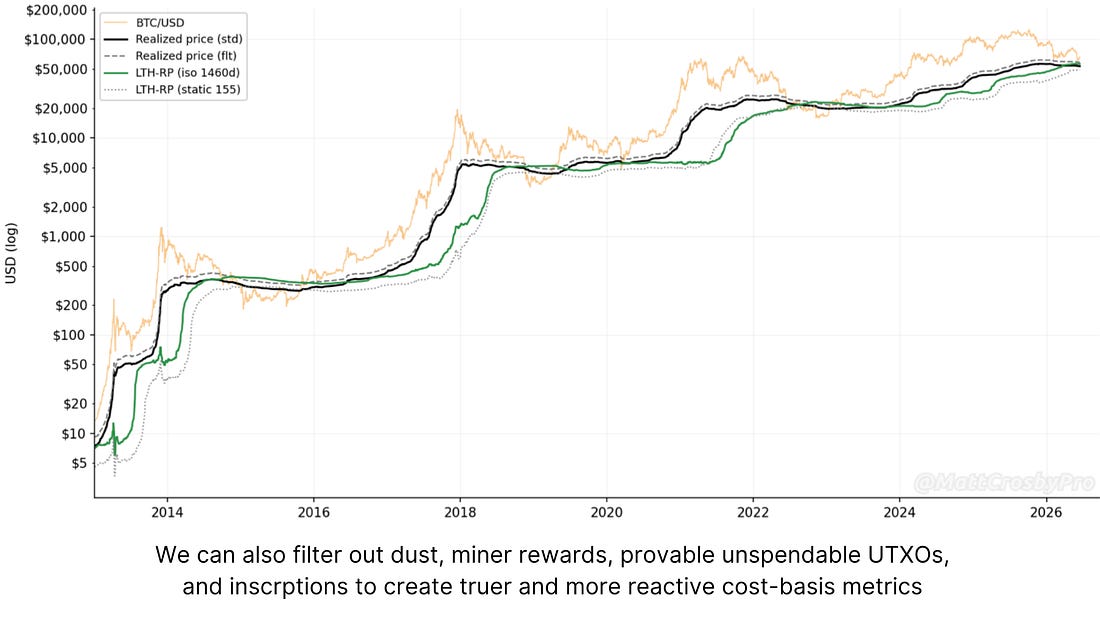
That might sound counterintuitive, a lower threshold for “long-term.” But it makes sense because people are holding as a store of value more than ever, and the point at which spending probability drops off now arrives sooner. You don’t need to hold as long before your likelihood of selling falls away significantly. A Cleaner Realized PriceThe second piece of this is the Realized Price, the average cost basis of all Bitcoin on the network, and arguably the single most important on-chain metric out there. The issue is that “all Bitcoin on the network” includes a lot of things that aren’t really economic transactions. There’s Bitcoin dust, which would cost more to send than it’s actually worth and is effectively unspendable. There are genuinely unspendable outputs. There are inscriptions, which exploded in volume from 2023 onward and aren’t really value-transfer transactions in any meaningful sense. And there are freshly mined coins, which arrive every ten minutes and aren’t immediately spent, so counting them at issuance and again when they eventually move risks double-counting. Filtering all of that out produces what I’d consider a truer realised price. It sits slightly higher than the standard version, because it stops counting the cost basis of coins that will realistically never move again.
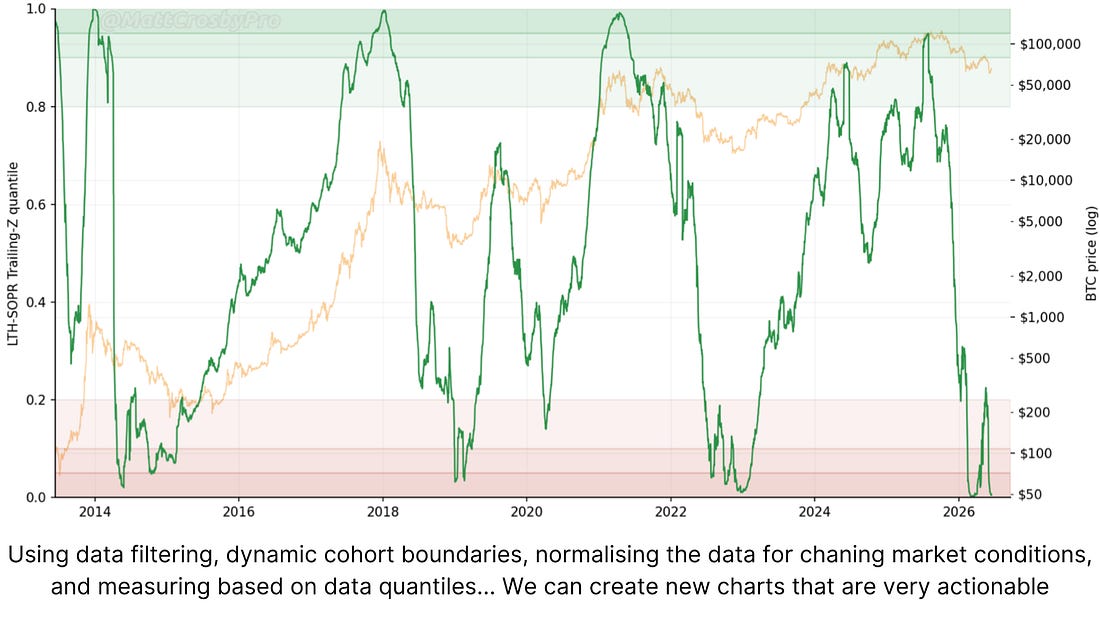
More Actionable SignalsThe real test of any new methodology isn’t whether it’s clever, but whether it produces something more useful. So I rebuilt the standard on-chain metrics on this new foundation. The long-term holder SOPR, which measures whether long-term holders are selling at a profit or a loss, becomes considerably sharper when built on the dynamic boundary and viewed through historical quantiles. It has marked Bitcoin’s major cycle tops and bottoms with notable precision. Right now, it’s sitting at a reading comparable to the recent $60,000 low, and some of the lowest levels it has ever recorded.
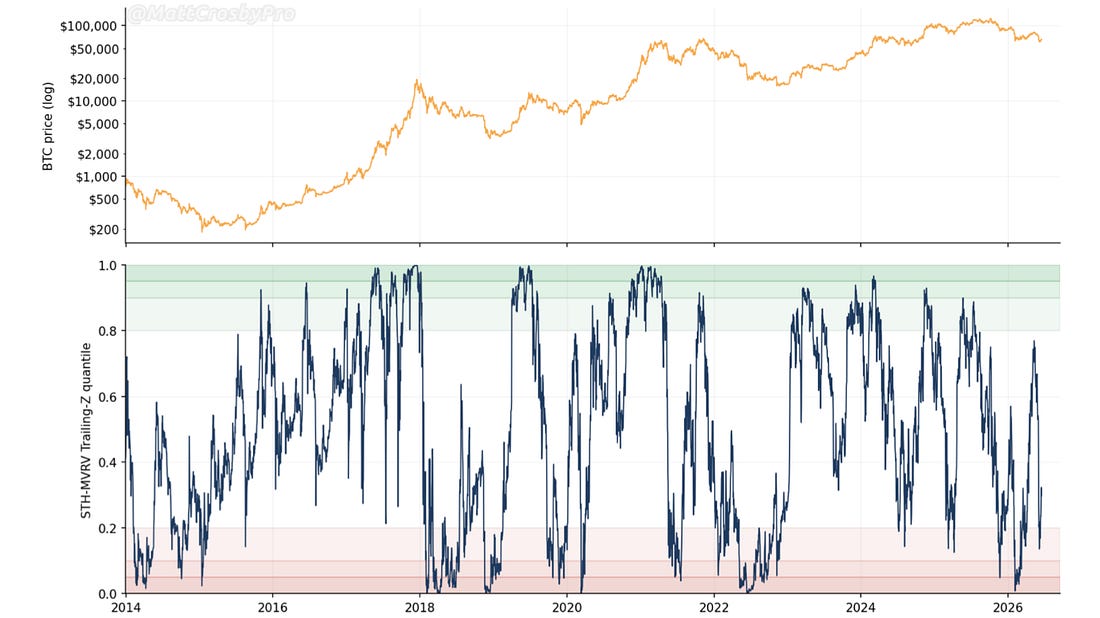
Applying the same approach to Short-Term Holder MVRV produces a similar improvement. The big upside spikes align with major price rallies, and the deep downside readings align with major turning points.
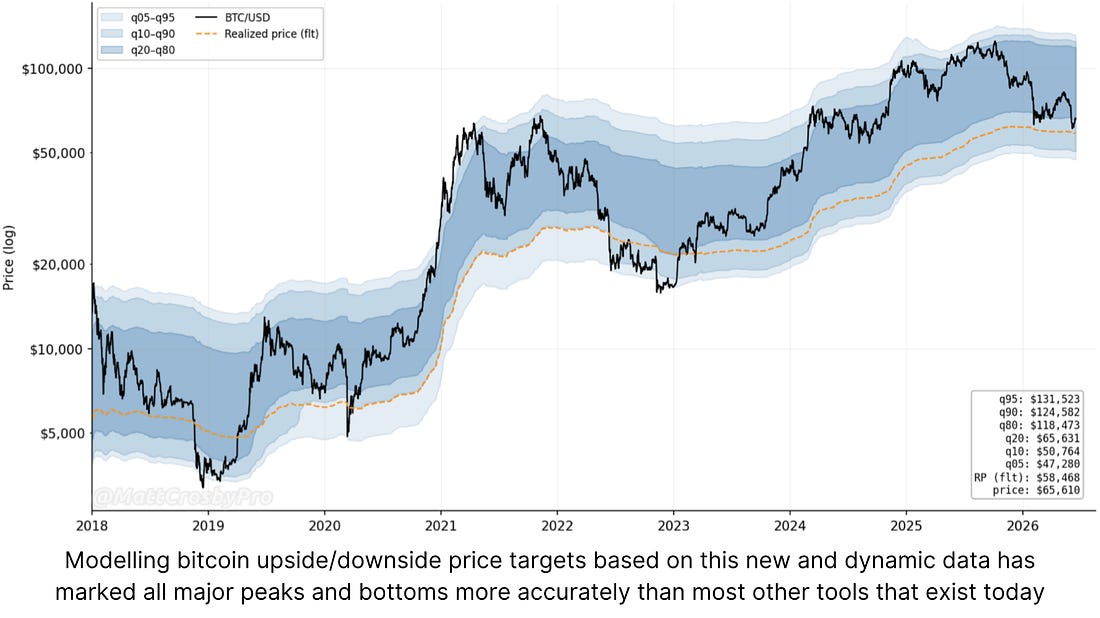
Where We Are NowTaking this quantile methodology and applying it to the filtered realized price produces upper and lower bands, a rough gauge of where Bitcoin might be heading based purely on real on-chain fundamental data, with no historical repainting. Viewed on a reactive, variable basis rather than through fixed thresholds, it’s been remarkably actionable.
Wrapping It All UpBear markets are for building. Rather than just waiting out the downside, this is exactly the kind of period to do genuinely useful work, and reworking one of the foundational thresholds of on-chain analysis felt like a worthwhile place to start. This is a first effort, and it’s fully open. Every formula and filter used is published so anyone can replicate it, test it, and improve on it. If the methodology can be made better, that benefits the entire space, and that’s the whole point. The metrics built on this new boundary appear more accurate, more reactive, and more actionable, and right now they’re all pointing to Bitcoin currently being in deep value territory. And watch our most recent YouTube video here: I Rebuilt Bitcoin’s 155-Day Holder Metric: It’s Now Even More Accurate 
Matt Crosby (@MattCrosbyPro) Director of Research & Analytics Bitcoin Magazine Pro
For more detailed Bitcoin analysis and to access advanced features like live charts, personalized indicator alerts, and in-depth industry reports, check out Bitcoin Magazine Pro. Make Smarter Decisions About Bitcoin. Join millions of investors who get clarity about Bitcoin using data analytics you can’t get anywhere else. We don’t just provide data for data’s sake, we provide the metrics and tools that really matter. So you get to supercharge your insights, not your workload. Take the next step in your Bitcoin investing journey:
Invest wisely, stay informed, and let data drive your decisions. Thank you for reading, and here’s to your future success in the Bitcoin market! Disclaimer: This newsletter is for informational purposes only and should not be considered financial advice. Always do your own research before making any investment decisions. We sincerely appreciate your support and hope you found this content valuable. Please leave a like and let us know your thoughts in the comments section; we always welcome feedback from our audience!
|







No comments:
Post a Comment