A trader withdrew $2M of ETH from Binance and swapped his entire stack to LIT in a single trade.
He received $14.1K back.
That's not a typo. The 0x router sent his order through a low-liquidity AVAIL pool, and Titan Builder's MEV bot backran the trade for a clean $2M profit. He lost 99% of his money in one click.
I can't tell if this was a genuine skill issue or some money laundering scheme. Either way, the lesson is the same: when you swap on EVM, use Llamaswap. It aggregates routes so your order never gets dumped into an empty pool.
Here’s what we got today:
Robinhood Chain launch. Introduction to the ecosystem.
DAO Governance attacks. And how to check if your token is vulnerable.
Around the web. Pumpfun integrates Robinhood tokens into their app, Solana onchain governance system, and more.
Today’s email is brought to you by Stacks — the smart contract layer of Bitcoin.
Here's your Edge 🗡️
Chain launch
Robinhood Chain: The Next Big Eco?
Source: robinhood.com/us/en/chain/
Robinhood has finally launched its much-anticipated chain.
One week in, the numbers say this wasn't just another L2 launch. Let's break it down.
Quick 80/20 on Robinhood Chain:
A purpose-built L2 for tokenized stocks, built on the Arbitrum Orbit stack and settling to Ethereum
ETH is the gas token. No new chain token to dump on you (yet)
100ms block times. That's 4x faster than Solana
Account abstraction (ERC-4337) baked in, and Robinhood is covering gas for eligible wallet users for the first 90 days
One catch: it runs on a single Robinhood-operated sequencer. Decentralization comes later, if ever. The censorship resistance is much weaker than Base.
Every new chain has the same cold-start problem: no users, no apps, no liquidity. You launch, you beg devs to deploy, you bribe degens with points.
But Robinhood already has the app, the brokerage brand, the wallet, the trading behavior, and around 28M customers across 38 countries, sitting on $307B in platform assets. Most chains spend years incentivizing users; Robinhood ships with pre-installed users.
And it didn't launch empty. The day-one ecosystem map already had 100+ teams: Uniswap, 1inch, and dYdX's new Arcus DEX on trading. Morpho, Ethena, Spark, and Maple on lending. Chainlink, LayerZero, BitGo, and Alchemy on infra. MetaMask, Ledger, and Trust Wallet on wallets.
That's a full DeFi stack waiting for users on day one, not a ghost town with a roadmap.
~329K cumulative active addresses in the first week
3.3M+ transactions
$368.65M in total asset market cap already sitting on the chain, $267.72M of it in stablecoins
$12.59M in tokenized stocks and ETFs
For a week-old chain in a deep bear market, that's a massive success. Fair caveat: gas is free for 90 days, so some of this activity is juiced. The honest read comes in October when the subsidy dies.
Of course, this is still crypto. So the first thing the chain got used for was a memecoin casino. Even Vlad Tenev leaned into it: "While we're building robinhood chain to be the best chain for RWA … it works great for memes too."
I'm not a fan. Memes can bootstrap activity, sure, but it’s an extraction machine. They're not why this chain matters. The interesting stuff is below.
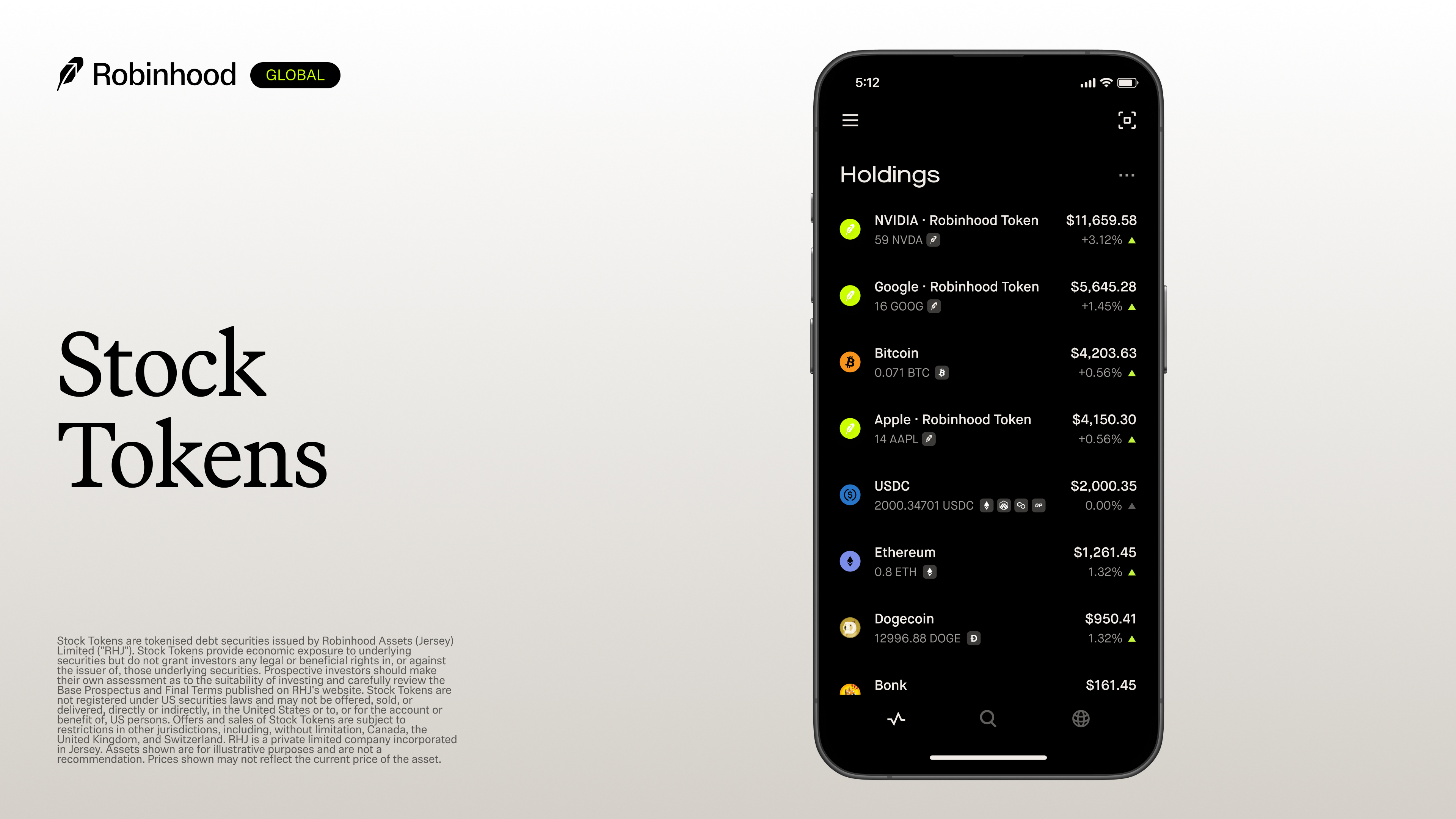
The whole point of Robinhood Chain is giving non-US users US equity exposure in a crypto-like format: transferable, composable, and usable inside DeFi.
These are ERC-20 tokens that track stocks and ETFs like AAPL, NVDA, and GOOG. You can trade them 24/7, move them to self-custody, lend them, or post them as collateral.
But read the fine print. These are not the same as holding actual shares. They're tokenized debt securities that give you economic exposure to the underlying stock. You get the price movement. You don't get voting rights or full shareholder protections.
They're live through Robinhood Wallet in 120+ countries, excluding US persons and restricted markets. Yes, you read that right: Americans can't touch Robinhood's flagship crypto product.
Robinhood Earn: the quiet giant
Eligible US users can lend USDG through a self-custody wallet and earn around 7% APY, powered by Morpho and curated by Steakhouse Financial.
A 7% stablecoin yield inside the Robinhood app sounds like a nice feature. I think it's the biggest business hiding in this launch.
Here's why. Robinhood sits on massive user cash balances. Historically, that cash goes into brokerage sweep programs and partner banks, and Robinhood clips a spread from the system.
If Robinhood moves even a small slice of those balances into onchain stablecoins like USDG, it stops being just a broker and becomes part of the stablecoin distribution economy. Distribution is where stablecoin profits concentrate, and Robinhood owns the customer relationship end to end.
That's where the real money is.
The Lighter integration (and its problem)
Perps come via Lighter, which is hosting a purpose-built instance of its protocol customized for Robinhood Chain. The architecture confused me at first, and I'm not sure it's the right call.
The problem: a fresh instance means bootstrapping liquidity from scratch. Perps live and die on liquidity depth, and a new venue starts at zero.
Something like Hyperliquid's builder codes makes more sense to me: plug into an existing liquid venue and share revenue, instead of spinning up an empty order book. My guess is Robinhood had regulatory reasons for wanting its own fenced-off instance. Understandable, but the liquidity problem doesn't care about your compliance memo.
Bitcoin is a $1.2 trillion asset, five times the size of Ethereum. Yet Ethereum runs a massive onchain economy while Bitcoin mostly has hodlers.
$BTC is the biggest pile of idle capital in crypto. And Stacks is where it goes to work: the Bitcoin L2 for smart contracts and DeFi.
sBTC is a key unlock. It’s a 1:1 Bitcoin-backed asset you can lend, borrow, and earn on, redeemable for BTC anytime. The deposit cap is fully gone, and sBTC hit $545M TVL in Q1, with $121M already deployed across Stacks DeFi.
The 2026 roadmap goes further: self-custodial BTC staking, native Bitcoin lending and borrowing, even a proposal to make sBTC the gas token. Yield, credit, and more, without giving up your keys.
Not everything's live yet (native staking lands later this year). But the direction is set. This is the home for Bitcoin-native finance.
Someone just spent ~$4M to legally vote themselves $20M.
No exploit. No stolen keys. No hack in any traditional sense. The attacker used BonkDAO's own governance rules, followed every step of the official process, and walked out the front door with the treasury.
And before you write this off as memecoin clown behavior, the same movie is now playing at ENS, one of Ethereum's most important pieces of infrastructure.
What happened?
On July 6, BonkDAO (the community DAO behind Solana's top memecoin, $BONK) lost roughly $20M in BONK from its treasury.
Here's the timeline:
June 30: An anonymous wallet submits a treasury-transfer proposal on Solana Realms.
July 4 to 5: A second wallet buys up 1% of the entire $BONK supply (~$4M) on the open market. That's all it took to meet quorum.
July 6: The vote closes. The attacker's proposal passes. ~$20M in BONK moves out.
Total cost of the attack: the price of the tokens. Which they still hold, by the way.
Why did it work?
Three failures stacked on top of each other:
A quorum of just 1% of supply. The attacker didn't need to social engineer anyone. They just bought the votes like groceries.
No effective timelock. There was no delay between the proposal passing and the treasury moving. Nobody had a window to react.
Nobody was voting. Only 7 addresses voted on a $20M decision. That's fewer people than your group chat. Attacker-linked wallets held ~99.878% of the votes cast.
The uncomfortable part: the attacker didn't break the rules. The rules were the vulnerability.
Now look at ENS.
Ethereum Name Service isn't a memecoin. It's foundational Ethereum infrastructure. And its DAO is going through something with eerily similar mechanics.
Quick 80/20 of the situation:
Katherine Wu (COO of ENS Labs) proposed moving the DAO's operational wallet, its ENS token holdings, and the Endowment over to the ENS Foundation.
Founder Nick Johnson announced he'd delegate his personal ENS to himself to vote on it. His ~3.26M ENS is only ~3% of total supply. But because voter participation is so low, it's roughly 50% of active delegated voting power.
Using that voting power, Johnson voted against extending the DAO's Security Council. That's the emergency multisig that can cancel malicious proposals before execution. The one safety mechanism BonkDAO didn't have.
After July 24, with the council expired, there's nothing standing between the Labs team and the DAO's $100M+ treasury.
The situation is still developing. And to be fair to ENS Labs: this is a public proposal, made by named people, with stated reasoning. It's not an anonymous wallet draining funds at 3 am.
But here's what both stories have in common: a small group is taking control of a DAO's funds using established governance processes.
BonkDAO shows what happens when an outsider exploits weak governance. ENS shows the same mechanics working for insiders, in broad daylight, with everyone watching. Different intent. Identical playbook: concentrated voting power, dead safety rails, and a voter base that's asleep.
Why this matters to you
If you hold tokens in any DAO, your treasury is exactly as safe as its governance design. Here's the 5-minute audit I'd run on every DAO token in your portfolio:
What's the quorum, and what would it cost to buy it? If it's less than the treasury's value, the DAO is an arbitrage trade waiting to happen. BonkDAO's was $4M guarding $20M.
Is there a timelock? A delay between vote and execution is the difference between "attack stopped" and "funds gone."
Is there a security council or veto mechanism, and who controls its survival? ENS had one. It got voted out of existence by a single delegate.
How concentrated is active voting power? Not token supply. Active voting power. 3% of supply became 50% of the vote at ENS because everyone else stopped showing up.
If a DAO fails two or more of these, the treasury isn't community-owned. It's just temporarily unclaimed.
🚀 DeFi Catalysts
Pump.Fun App has integrated Robinhood Tokens. Users can now trade those tokens seamlessly without bridging.
Summer.fi's Lazy Summer Vault was exploited for ~$6.04 million. The DAO will decide on compensating the users via their forum.
Virtuals has launched Agent Tokenization on Robinhood Chain. Creation, funding, ownership, and autonomous operation are available there.
Solana has launched onchain governance system. Any validator with at least 100k SOL delegated can open a Solana Governance Proposal (SGP).
VALR, Africa's largest crypto exchange by trading volume, is now using Hyperliquid as the onchain layer to bring perpetuals to its users.
Robinhood Wallet users can now trade perps and Stocks Tokens directly through Lighter on Robinhood Chain.
Variational introduced "Swaps", a new onchain OTC derivatives instrument to bring TradFi onchain.
Jito will launch JTX, their trading platform, next week. It has positioned itself as the platform for advanced traders.
Stacking DAO announced stBTC. It'll be the liquid version of the upcoming native BTC staking on Bitcoin L1 by Stacks.
Berachain completed its hardfork upgrade. They have stopped BGT emissions and have transitioned into the PoL Next incentive model built around SWBERA.
Meridian has rebranded fromPrediction Markets on Ethereal and launched on Robinhood Chain as a day-one partner.
📰 Industry News
DefiLlama introduced the Risk Scenario Planning tool for Morpho Vaults. It maps protocol dependencies and estimates users' maximum losses across potential failure points.
Cloudflare announced Monetization Gateway. It'll let you charge per access for any resource behind Cloudflare: web pages, APIs, datasets, or MCP tools.
Polymarket gets sued by two traders over disputed resolution of the Strategy Bitcoin sale market.
DISCLAIMER: I'm NOT a financial advisor. This content is for education and information purposes only. Crypto and DeFi are risky and speculative. Please do your research before investing.
Whenever you're ready, here's how we can help you:
🚀 The DeFi Edge Ventures- We identify, invest, and help amplify DeFi Protocols that positively impact the Crypto space.
You're receiving this email because you signed up for my newsletter. You can update your Preferences or Unsubscribe here.
600 1st Ave, Ste 330 PMB 92768, Seattle, WA 98104-2246


No comments:
Post a Comment