| gm Bankless Nation,
Coinbase's Base L2 is ditching the OP Stack in a move that sent shockwaves throughout Crypto Twitter this morning. Today's Issue ⬇️ - ☀️ Need to Know: Base's Optimism Breakup
The Coinbase L2 ditches Optimism's OP Stack. - 🗣️ Analysis: What's New in Offline Protocol 2.0
Taking on government control with decentralized tech.
p.s. Thanks to Rocket Pool. Rocket Pool’s Saturn upgrade is here: RPL stakers can earn ETH via the fee switch, and 4-ETH validators + Megapools are live. Stake your ETH with Rocket Pool! Sponsor: Ready (formerly Argent) — Spend USDC worldwide with zero FX fees and up to 3% cashback.
. . . NEED TO KNOW Base's Big Move - 🔵 Coinbase Abandons Optimism's OP Stack in Seismic Shift. Base devs believe they can ship faster by bringing technical development in-house, dealing a major blow to Optimism's Superchain dream.
- 🤖 OpenAI and Paradigm Introduce 'EVMbench' for AI Agent Benchmarking. EVMbench measures how well AI agents can detect, exploit, and patch high-severity smart contract vulnerabilities.
- 👨⚖️ Crypto Lawyer Jake Chervinsky Launches Hyperliquid Policy Center. Chervinsky will serve as CEO of the newly formed Hyperliquid-backed crypto lobby group.
📸 Daily Market Snapshot: ETH fell below $2,000 once more and BTC battled the $65K barrier as crypto markets again slumped despite a green day for stocks. | Prices as of 6pm ET | 24hr | 7d |  | Crypto $2.29T | ↘ 2.0% | ↘ 1.6% |  | BTC $66,234 | ↘ 2.0% | ↘ 2.1% |  | ETH $1,939 | ↘ 3.0% | ↘ 1.1% |
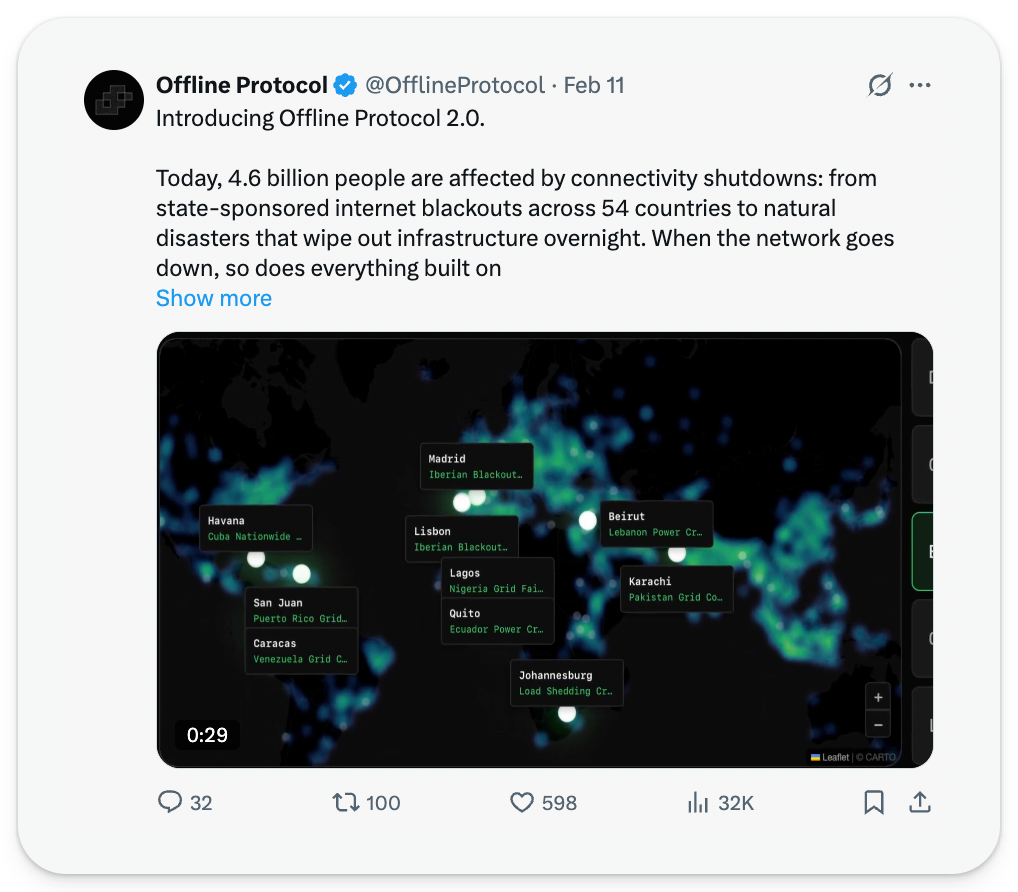
. . . ANALYSIS Offline Protocol 2.0's Blackout-Proof Messaging App Governments are getting better at pulling the plug. The United Nations confirmed last month that 2024 was the worst year for internet shutdowns on record, with 296 government-induced outages across 54 countries. The trend has carried into 2026. Afghanistan, Nepal, Tanzania, and Iran have all imposed blanket shutdowns or sweeping platform bans over the past several months, typically during protests or elections. Iran's blackout in January was among the most severe where mobile networks and most landlines went dark entirely, making phone calls to emergency services impossible. What connectivity survived came through smuggled Starlink dishes: the channel for the outside world learning what was happening. Given the level of connectivity our modern world turns on, when the internet goes down, so too do our identities, our money, and our ability to organize or communicate beyond shouting distance. Authoritarian governments know this, and also know the infrastructure providing these services can be seized. Thankfully, there’s a growing number of developers building around that assumption entirely, creating tools to ensure connectivity is sovereign, rather than seizable. Offline Protocol is one of them, and they released a significant update last week. Where Things StoodLast July, I covered Offline Protocol as part of a broader look at censorship-resistant communication tools. At the time, the pitch centered on Fernweh, a mesh messaging app that let users communicate device-to-device via Bluetooth and Wi-Fi Direct, with no cell towers or Internet Service Providers (ISPs) required. The vision was clear, though the infrastructure underlying it remained implicit. What's Different NowThe core shift in Offline Protocol 2.0 is architectural. The team has spent the past year formalizing the foundation underneath Fernweh into a documented infrastructure stack built on three core components: - DORS (Dynamic Offline Relay Switch) is the mesh networking protocol itself, responsible for routing data across communication networks formed by nearby devices. To do this, DORS actively selects the best path based on signal strength and proximity, factoring in things such as avoiding routing through devices running low on battery or how best to navigate crowded environments.
- OfflineID is a decentralized identity system that lives locally on your device. It lets users cryptographically prove who they are without any internet connection, useful when the systems that originally issued their credentials are unreachable. Currently, 300K users across 80+ countries hold OfflineIDs.
- Proof of Location adds a novel verification layer that confirms a person's real-time presence and authenticity without biometric surveillance. Rather than relying on GPS APIs or centralized location oracles, PoL is determined by independent operators who validate location claims by measuring how long it takes signals to travel between nearby devices - essentially using signal speed as a way to confirm someone is actually where they say they are. Results are signed and posted onchain, creating an immutable record with no biometric data required or stored centrally.
Together, these three form a foundation, which the application layer is, and will be, built on top of. What You Can Actually UseWhen it comes to applications right now, only one product is live: Fernweh V2. The original Fernweh messaging app was mesh-only, operating over two radio protocols: WiFi Direct covers up to 200 meters between devices, while Bluetooth extends up to 100 meters. Messages that need to travel farther hop between devices automatically, with the network caching them along the way until they reach their destination (if there’s a route available). V2 adds hybrid connectivity, meaning the app now routes messages through the mesh when internet is unavailable and switches automatically to internet when it's available. It supports one-to-one messages, group chats, and broadcast alerts to nearby nodes. It's already at 35K+ downloads and operating within more than 10K mesh clusters across 80+ countries, a huge jump from the 500 users live last July when we first covered it. What's ComingWhile the infrastructure has become significantly more robust, firming up Fernweh, the Offline Apps teased last July remain in development, though more have been added to the repertoire. - OfflinePay is the most ambitious, and Fernweh's missing half. Positioned as the world's first offline stablecoin settlement network, it enables P2P crypto payments across multiple chains and currencies with no internet connection required, with transactions slated to settle directly between devices.
- Mesh Network Rewards has been introduced as an incentive layer for the protocol. Users who run nodes and relay data anonymously through the mesh earn rewards for their contribution to the network. This is important because mesh networks are only as strong as their density. Rewarding participation directly is how you grow coverage in the places that need it most.
- Diffuse is a citizen journalism app. It aggregates and verifies news via the mesh network itself, uses censorship-resistant storage, and applies tamper-proof deduplication to prevent manipulation. In environments where state-controlled media is the only broadcast signal, local truth needs its own distribution layer.
The developer platform is already live. Offline Protocol has published SDKs for iOS, Android, and Web, along with quickstart guides for building apps with OfflineID integrated – so the third-party app ecosystem can start forming now rather than waiting for a separate launch.  via Offline Protocol The Honest AssessmentThe gap between infrastructure and application is real, and Offline Protocol is living in it right now. I'm excited to see this gap close, hopefully soon. There's also a harder question underneath all of this, which is whether consumer adoption can happen before the crisis moments that demand it. Starlink punched through Iran's blackout in January because devices had already been smuggled in. The mesh needs density to work. A sparse network in a city under shutdown is less useful than a dense one, and you don't build density in a crisis. (A reality which makes the introduction of an incentive layer quite important.) Reviewing Offline, it's hard not to notice the broader divergence happening at the application layer across crypto right now. On one side, a seemingly endless conveyor belt of speculation. On the other, a determined push toward something more difficult to build and easier to underestimate: sovereign technology. Just as demand is driving increased speculation, so too, sadly is demand driving these technologies as authoritarian regimes and tendencies are blooming globally. Even if there's not an immediate need for you to download Fernweh, I'd recommend getting it set up, testing it out, and if you're lucky enough to have close friends and family within a distance, choosing to use it. Not to be alarmist, but as I've stated, it's best to know how to use these technologies before they're needed. FRIEND & SPONSOR: READY (FORMERLY ARGENT) Ready makes going bankless simple. With the Ready app, you can buy crypto, earn yield, and stay in control of your assets. Spend USDC anywhere Mastercard is accepted with the Ready Card, with zero fees and 3% cashback. Bankless readers get 20% off Ready Metal with code: BANKLESS20 |







No comments:
Post a Comment